
AI in digital marketing is the present and the future of performance-driven growth, not just a sci-fi idea. AI in digital marketing is changing the way brands interact with their audiences through personalized customer journeys, paid advertising automation, and SEO optimization.
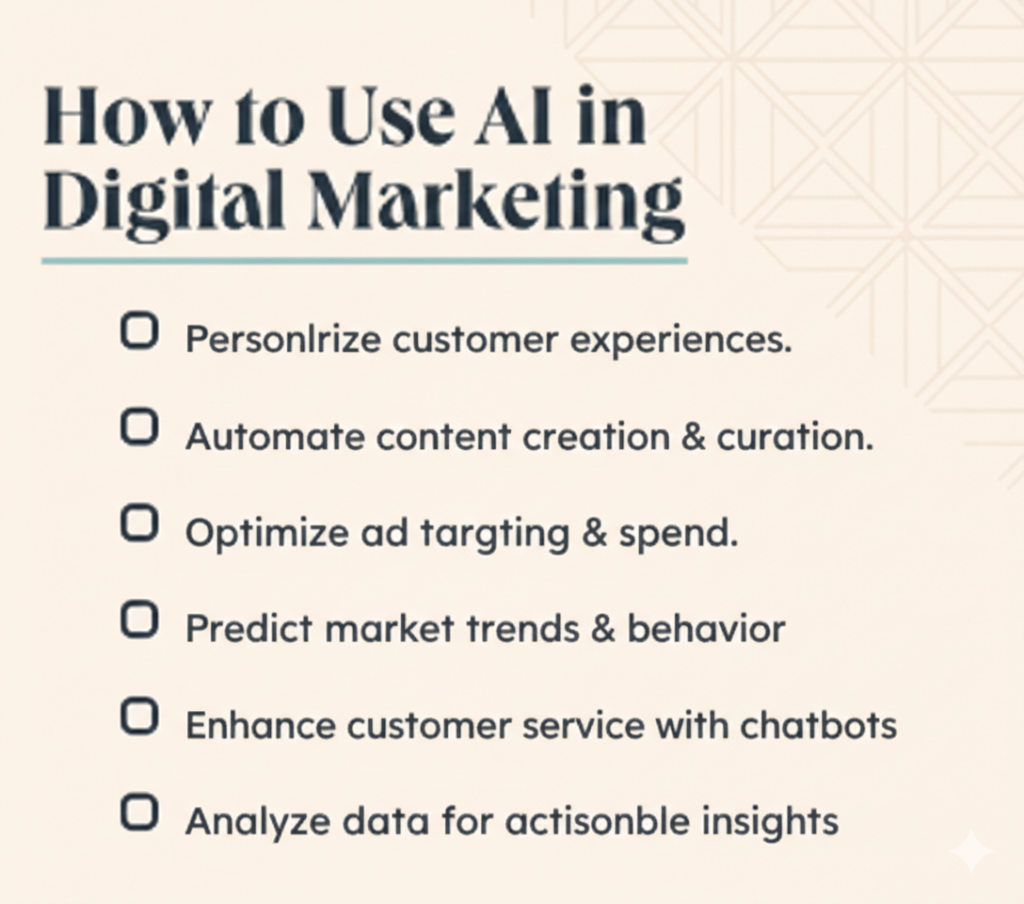
Companies in Abu Dhabi, the United Arab Emirates, and around the world are using AI in digital marketing to increase customer engagement, decrease wasteful ad spending, improve targeting accuracy, and produce quantifiable ROI. We examine how AI is changing digital strategies, what it means for SEO and paid media, and how to use it efficiently in this comprehensive guide.
What Is AI in Digital Marketing?
Artificial intelligence (AI) in digital marketing is the application of AI technologies, including automation, machine learning, natural language processing, and predictive analytics, to enhance decision-making and optimize marketing strategies.
AI in digital marketing allows systems to do the following instead of depending only on human analysis: Analyze large datasets in real time
- Forecast the actions of customers
- Automatically improve ad targeting
- Customize content in real time.
- Continuously enhance the campaign’s performance
The objective is: data-driven, more intelligent marketing choices.
How AI in Digital Marketing Is Transforming SEO
AI is now widely used by search engines themselves. In order to comprehend user intent and context, Google’s algorithm updates mainly rely on machine learning models.
Example: Google Algorithm Changes
In recent years, Google has made significant changes to its algorithm, including the addition of AI-based models that assess content quality in ways other than keyword matching. The algorithm now gives priority to the following factors rather than just keyword density when ranking pages:
- Semantic relevance and content depth
- Signals of user engagement
- Authority, Trust, Experience, and Expertise (E-E-A-T)
- Contextual meaning as opposed to keywords that match exactly
For instance, a page that discusses “automotive marketing strategies” and goes into great detail about subtopics like paid advertisements, SEO, social media, and lead funnels will perform better than one that just uses the keyword several times.
This illustrates the connections between AI in search engines and AI in digital marketing. Marketers must adapt their tactics to the way AI assesses content if they want to rank well.
AI in Digital Marketing for Paid Advertising
One of the most significant changes brought about by AI in digital marketing has been in paid media.
AI-driven automation is now used by platforms like Google Ads and Meta Ads to:
- Real-time bidding strategy optimization
- Determine the audience segments that convert well.
- Estimate the probability of a purchase
- Spend money on the best-performing advertisements.
Example: Smart Bidding
Google’s AI automatically modifies bids for higher conversions by analyzing millions of signals, including device type, location, time of day, and search activity. This frees up marketers to concentrate on strategy instead of making manual bid adjustments.
When used properly, artificial intelligence (AI) in digital marketing greatly increases return on ad spend and lowers cost per acquisition.
AI in Digital Marketing for Content Creation
These days, AI tools help with:
- Recommending clusters of keywords
- Creating content outlines
- Making variations of ad copy
- Customizing email marketing
- Improving headlines to increase click-through rates
Even though AI speeds up production in digital marketing, human oversight is still crucial. To guarantee accuracy, brand alignment, and adherence to E-E-A-T standards, AI-generated content needs to be examined.
The most effective digital strategies blend human creativity with AI efficiency.
AI in Digital Marketing and Customer Personalization
One of the biggest advantages of AI in digital marketing is personalization.
Businesses can use AI to:
- Make tailored product recommendations
- Based on behavior, initiate automated email sequences.
- Adapt landing pages on the fly
- Divide audiences according to predictive models
For instance, an Abu Dhabi-based e-commerce business can use AI to display different homepage banners to new and returning customers, increasing the likelihood that they will make a purchase.
At scale, this degree of personalization was previously unattainable.
AI in Digital Marketing for Data Analytics
Reports from traditional marketing analytics had to be manually interpreted. Dashboards powered by AI now offer insights like:
- Forecasting predictive revenue
- Automated detection of anomalies
- Performance alerts in real time
- Forecasts of customer lifetime value
AI in digital marketing transforms decision-making from reactive to proactive.
Challenges of AI in Digital Marketing
Despite its strength, AI in digital marketing has drawbacks.
- Excessive automation without a plan
- Concerns about data privacy and compliance
- Over-reliance on content produced by AI
- Consistency in brand voice is lost.
Implementing AI strategically is crucial; it should complement marketing rather than take the place of human knowledge.
Future of AI in Digital Marketing (2026 and Beyond)
In the future, AI in digital marketing will keep developing in areas like: AI-powered search experiences
- Conversational and voice search optimization
- Audience prediction modeling
- Extremely customized advertising
- Automated optimization of content performance
In order to stay competitive, marketers need to modify their tactics as search engines depend more on AI algorithms.
How to Implement AI in Digital Marketing Effectively
Businesses should use AI tools for keyword research and SEO audits in order to use AI in digital marketing.
- In paid campaigns, use automated bidding.
- Use platforms for predictive analytics.
- Integrate human strategy with AI-generated insights.
- Test and improve campaigns on a regular basis.
Sustainable growth is ensured by the combination of strategic oversight and automation.
Conclusion
Brands’ approaches to SEO, paid media, content production, and customer interaction are being redefined by AI in digital marketing. Artificial intelligence is now at the center of digital performance, from Google‘s AI-driven algorithm modifications to personalization and predictive advertising.
Smarter targeting, better data interpretation, and increased campaign efficiency give businesses that strategically use AI in digital marketing a competitive edge.
The most important lesson learned is that AI is enabling marketers to make quicker, more intelligent, and more lucrative decisions rather than replacing them.