
The way Google and other search engines rank and display content is being completely transformed by AI search and SGE (Search Generative Experience). These changes in the search landscape as 2026 approaches require marketers and content producers to reconsider their SEO tactics.
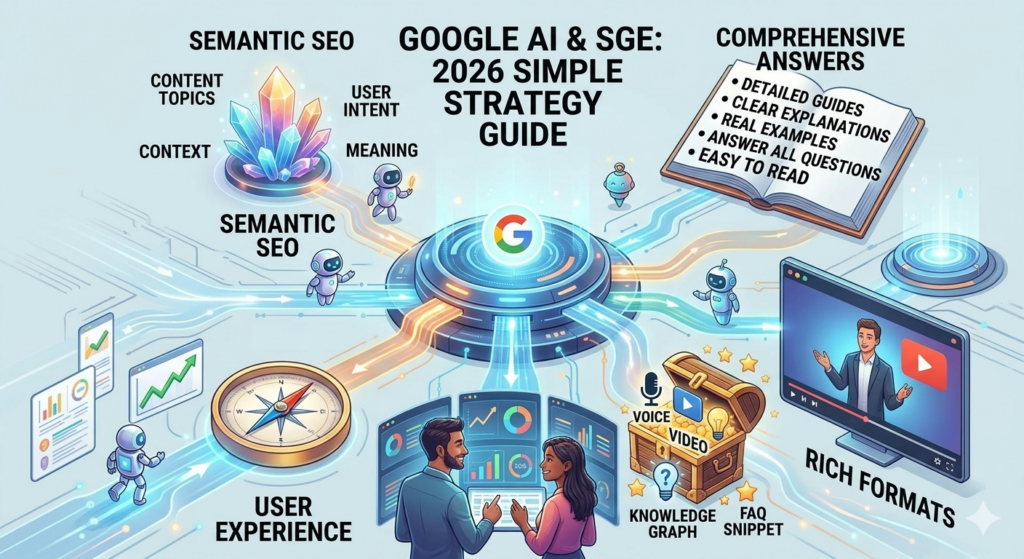
In order to remain competitive, raise rankings, and draw in high-intent traffic in this new search era, we’ll look at how to optimize content for AI search and SGE in this 2026 strategy guide.
What is AI Search and SGE?
AI Search
The term “AI search” describes how search engines employ artificial intelligence to better comprehend user queries and provide pertinent results. AI search employs machine learning and natural language processing to comprehend context, intent, and even semantic meaning of content, in contrast to traditional search engines that only use keyword matching.
SGE (Search Generative Experience)
Google’s SGE offers a more dynamic user experience by combining traditional search with generative AI. Instead of only ranking pages, SGE allows Google to produce answers directly from content. Accordingly, SEO optimization for AI search and SGE focuses more on giving the AI access to thorough, contextually relevant data.
How to Optimize Content for AI Search and SGE in 2026
1. Focus on Semantic SEO and Contextual Relevance
Going beyond keyword optimization and adopting semantic SEO is the best way to optimize content for AI search and SGE. This strategy emphasizes the relevance of the content and the context surrounding keywords.
Example:
Assume you are writing about “AI-powered SEO tools.” You should incorporate related terms like “machine learning in SEO,” “AI content optimization,” and “automated keyword analysis” in addition to the keyword “AI-powered SEO tools.” After that, AI search algorithms will comprehend the larger context and give your content a higher ranking for more relevant searches.
Actionable Tip:
Incorporate semantic keyword clusters into your writing. These are collections of connected terms that support the main keyword’s context.
2. Create Comprehensive, Answer-Focused Content
Comprehensive responses are given priority by SGE and AI search. It won’t be enough to just write an article that focuses on a keyword. Users’ questions must be fully addressed in your content.
Example:
Let’s say the question is “How to optimize content for SGE.” Rather than writing a brief blog post, your content ought to:
- Provide detailed instructions on how to optimize for SGE.
- Describe SGE, its operation, and how it affects SEO.
- Give instances of effective SGE optimizations from websites with high search engine rankings.
This content will be used by Google’s AI and SGE to directly produce answers in the search results, which could greatly boost visibility.
Actionable Tip:
Clear, readable subheadings and bulleted lists that provide thorough answers to questions should be used to organize your content.
3. Focus on User Experience and Intent
The purpose of Google’s AI search models is to comprehend user intent. Your content is more likely to rank higher in the new AI-driven search environment if it is clear, helpful, and easy to read.
Example:
“Best digital marketing strategies for UAE businesses” is what a user looks up. A list of strategies is not enough; you also need to explain why and how these strategies specifically apply to businesses in the United Arab Emirates, as AI search will prioritize content that addresses their intent.
Actionable Tip:
To improve engagement and user experience signals, use interactive elements (such as polls or forms) and clear calls to action (CTAs) to direct users through your content.
4. Optimize for Featured Snippets and Structured Data
Featured snippets will be more crucial than ever since SGE will produce answers directly from content. SGE will use your content for quick answers if it is optimized for rich snippets and structured data (such as reviews, FAQs, and how-to schemas).
Example:
Make a FAQ schema that addresses the most frequently asked questions about AI search optimization in order to rank for “how to optimize for AI search.” Google’s AI will find it simpler to retrieve your content for voice search and direct answers as a result.
Actionable Tip:
To improve your chances of being included in rich snippets, use FAQ markup and structured data.
5. Embrace Video and Interactive Content
Video content and interactive features will be given more importance as AI search and SGE develop further. AI is already used by Google to index and transcribe videos, so incorporating it into your content strategy is essential.
Example:
Make a video that summarizes your blog post about content optimization for SGE and incorporate it into your piece. Make sure the video content is in line with the search intent and provide a transcript. The video can be pulled by AI search engines to appear in answer boxes and video carousels.
Actionable Tip:
Use transcripts to improve AI indexing and optimize your video‘s title, description, and tags with pertinent keywords.
Conclusion
In order to remain competitive in the changing SEO landscape in 2026, content optimization for AI search and SGE is essential. You can make sure that your content is AI-friendly and positioned for high rankings in Google’s new search environment by concentrating on semantic SEO, user intent, comprehensive content, and structured data.
Search is evolving, and AI in SEO and SGE will keep changing how companies interact with their customers. Optimize for intent, context, and user experience rather than just keywords.