
Introduction
AI, performance, and SEO are all connected in some way. Optimizing Websites for Speed is changing the way websites are built, improved, and ranked. In 2026, website speed is no longer just a technical measure; it is a key factor in SEO performance, user experience, and conversion rates.
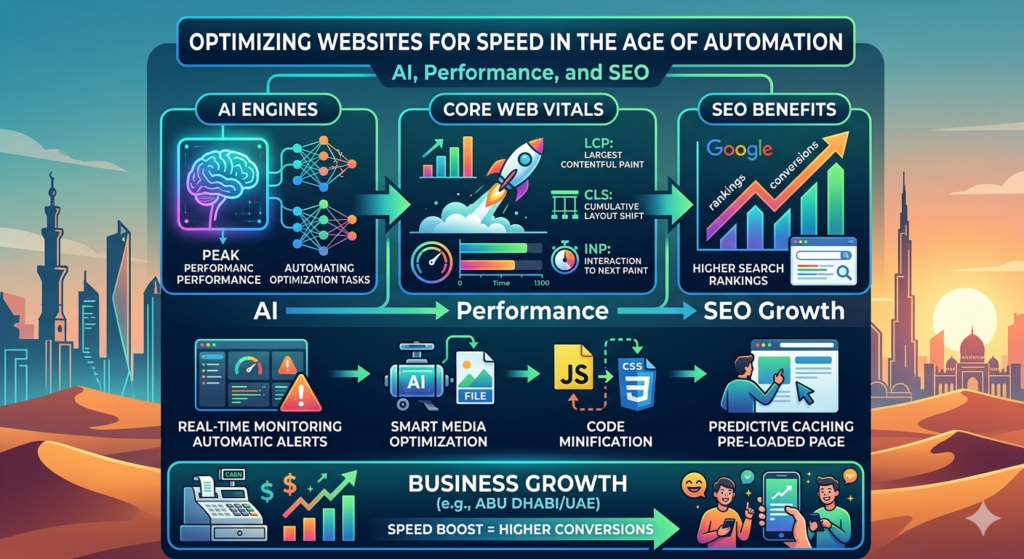
Businesses need to pay attention to AI, performance, and SEO as search engines get smarter and users’ expectations rise: In the age of automation, you need to make sure your websites load quickly to stay competitive. AI-powered automation is changing the way websites load, respond, and change in real time.
Why Website Speed Is Critical for SEO in 2026
When talking about AI, performance, and SEO: In the age of automation, speed is one of the most important factors for ranking websites.
A website that loads slowly has a direct effect on:
- Rate of Bounce
- Rate of conversion
- Time spent engaging
- Rankings in search engines
Google puts websites that load quickly at the top of its list because they are better for users. In very competitive markets like Abu Dhabi and the UAE, even a one-second delay can cost a lot of money.
How AI Is Transforming Website Performance Optimization
A big change in AI, performance, and SEO: The role of AI in automating performance improvements is to make websites faster in the age of automation.
1. Real-Time Performance Monitoring
AI tools can keep an eye on websites for problems with performance and fix them on their own.
For example:
AI monitoring on an e-commerce site found that product pages were loading slowly because the images weren’t optimized. The system automatically compressed images and made them load faster, which led to a 20% increase in conversions.
2. Smart Image and Media Optimization
One of the main reasons websites load slowly is because of images. AI can change images to make them look better without losing quality.
This is an important part of AI, performance, and SEO: In the age of automation, speeding up websites is important, especially for industries that rely heavily on visuals, like real estate and cars.
3. AI-Based Code Optimization
AI can look at the structure of code and get rid of things that aren’t needed, like JavaScript and CSS that aren’t used.
This makes the page smaller and loads faster, which has a direct effect on SEO rankings.
4. Predictive Loading and Caching
AI guesses what users will do and loads content before they ask for it.
For example:
AI might preload the contact page if a user is looking at a service page. This would speed up the page load time and make it more likely that the user will convert.
Core Web Vitals and AI Optimization
Improving Core Web Vitals is an important part of AI, Performance, and SEO: Optimizing Websites for Speed in the Age of Automation.
Important Numbers:
- Largest Contentful Paint (LCP): How fast the main content loads
- Cumulative Layout Shift (CLS): How stable the visuals are
- Interaction to Next Paint (INP): Responsiveness
AI tools automatically keep an eye on and improve these metrics to make sure that websites meet Google’s performance standard.
SEO in the Age of Automation
Keywords are no longer the only thing that matters in SEO. In AI, Performance, and SEO: Optimizing Websites for Speed in the Age of Automation, search engines look at:
- Speed of the page
- Experience with the user
- Content that is relevant
- Performance on mobile
- Signs of engagement
AI-driven algorithms put websites that offer fast, smooth experiences at the top of the list.
Best Practices for AI-Driven Website Speed Optimization
To do well in AI, performance, and SEO: In the age of automation, businesses should use the following strategies to speed up their websites:
1. Use tools that use AI to improve performance
AI tools can find and fix performance problems on their own in real time.
2. Use Lazy Loading
When users scroll, only load images and content. This cuts down on the time it takes to load the page.
3. Improve Hosting and CDN AI-powered CDNs send content to users faster based on where they are.
4. Cut down on HTTP requests
To make pages load faster, cut down on the number of elements on each one.
5. Optimizing for mobile first
Make sure your website works perfectly on mobile devices, especially in the UAE where most people use mobile devices.
Real-World Example: Performance Optimization in Abu Dhabi
A service-based business in Abu Dhabi had a lot of visitors but few sales because their website was slow.
Using AI, Performance, and SEO: In the Age of Automation, they:
- Making Websites Faster
- The time it takes for a page to load went from 5 seconds to 2 seconds.
- Better Core Web Vitals
Used AI tools to improve images and scripts
The results are:
- Conversions went up by 35%
- Less bouncing
- Higher rankings in search engines
This shows that optimizing speed has a direct effect on business growth.
The Future of AI, Performance, and SEO
The future of AI, performance, and search engine optimization: In the age of automation, optimizing websites for speed is going in the direction of:
- Websites that optimize themselves
- Changes to performance in real time
- AI-driven personalization of the user experience
- Faster indexing and ranking
Companies that start using AI early will have a big edge over their competitors.
Conclusion
To be successful in the digital world today, you need to know about AI, performance, and SEO. You also need to know how to make websites faster in the age of automation. AI optimization directly affects rankings, user experience, and conversions by speeding up websites.
To stay ahead in search rankings and give customers smooth digital experiences, businesses need to add AI to their performance strategies as automation continues to change.