
Introduction
The idea of synthetic audiences: the future of targeting in performance Marketing is changing how brands do digital advertising very quickly. Marketers are moving away from traditional user data and toward AI-driven targeting methods as privacy laws get stricter and third-party cookies disappear.
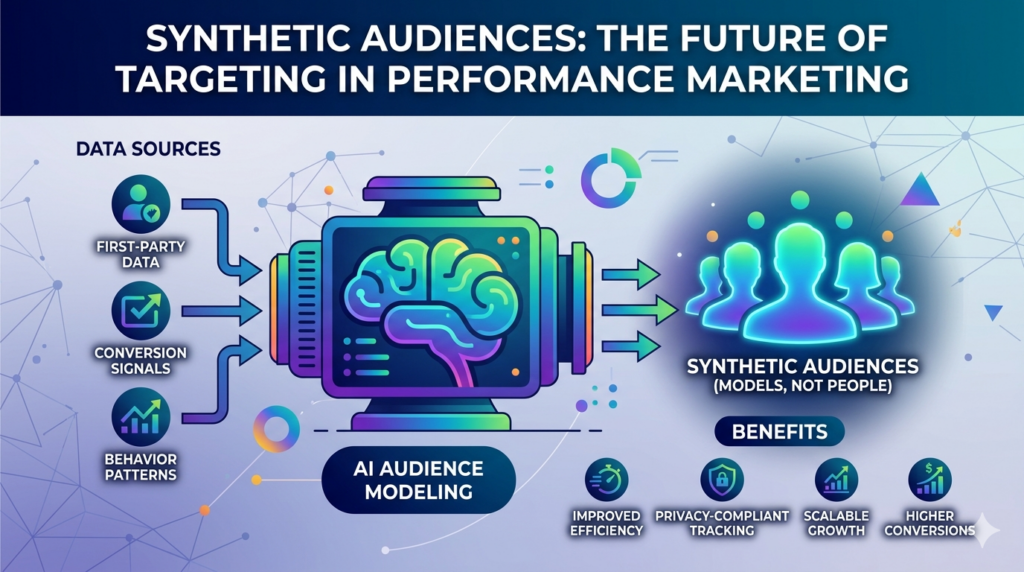
Synthetic Audiences: The Future of Targeting in Performance Marketing is a powerful answer to the changing world we live in. Synthetic audiences don’t go after real users directly. Instead, they use machine learning models to create high-converting customer profiles. This lets brands scale campaigns with accuracy and speed.
What You Need to Know About Synthetic Audiences: Businesses that want to stay competitive in 2026 and beyond need to know about The Future of Targeting in Performance Marketing.
What Are Synthetic Audiences?
When you look at existing customer data and find patterns in the behavior of high-performing users, you can create synthetic audiences, which are AI-generated groups of people. These audiences are not real people; they are modeled profiles based on things like behavior, interests, and conversion signals.
In Synthetic Audiences: AI uses data like this to help with targeting in performance marketing:
- Conversions in the past
- How the website works
- Patterns of engagement
- History of purchases
- Signals about demographics
This lets platforms guess who is most likely to convert and target them, even if they have never interacted with your brand before.
Why Synthetic Audiences Are the Future of Targeting in Performance Marketing
The rise of synthetic audiences: the future of targeting in performance Big changes in the industry are driving marketing:
1. Advertising that puts privacy first
Because of stricter privacy laws and less access to user-level data, traditional targeting methods are not working as well as they used to. Synthetic audiences let advertisers keep doing well without having to use invasive tracking.
2. Prediction with AI
AI can look at thousands of pieces of data at the same time. This makes Synthetic Audiences: The Future of Targeting in Performance Marketing much easier to use on a large scale than manual audience segmentation.
3. Higher rates of conversion
Synthetic audiences are made using conversion data, so they usually work better than broad or interest-based targeting.
How Synthetic Audiences Work in Performance Marketing
When it comes to Synthetic Audiences: The Future of Targeting in Performance Marketing, platforms like Google and Meta use machine learning to:
- Look at customers who are worth a lot
- Find patterns in behavior
- Make models of your audience that can predict what they will do
- Send ads to people who are similar to each other.
This process happens in real time, and as more data is collected, performance gets better and better.
Real-World Example of Synthetic Audiences
A real estate company in Abu Dhabi wanted to get good leads for high-end apartments. They didn’t try to reach a wide range of people; instead, they used synthetic audience modeling based on people who had bought from them before.
- The system found patterns like:
- Professionals who make a lot of money
- Users looking at high-end property listings
- Regularly looking at real estate content
Using Synthetic Audiences: The campaign was successful in the future of targeting in performance marketing.
- The cost per lead is 35% lower.
- More useful questions
- Higher rates of conversion
This example shows that AI-driven targeting works better than traditional audience selection.
Synthetic Audiences vs Traditional Targeting
Understanding Synthetic Audiences: The Future of Targeting in Performance Marketing requires comparing it to traditional methods:
| Traditional Targeting | Synthetic Audiences |
| Based on demographics | Based on predictive behavior |
| Limited scalability | Highly scalable |
| Manual segmentation | AI-driven automation |
| Lower accuracy | Higher conversion potential |
This shift represents a major transformation in performance marketing strategy.
Benefits of Synthetic Audiences in Performance Marketing
1. Better campaign efficiency
Synthetic audiences help you spend less on ads by focusing on users who are more likely to convert.
2. Growth that can be scaled
Synthetic Audiences: The Future of Targeting in Performance Marketing lets campaigns grow without losing quality, unlike manual targeting.
3. Faster optimization
AI learns and gets better at targeting audiences all the time, in real time.
4. Following the rules for privacy
Synthetic audiences fit with the trend of privacy-first advertising, which means less reliance on personal data.
Challenges of Synthetic Audiences
Synthetic Audiences: The Future of Targeting in Performance is a strong book. There are also problems with marketing:
- Reliance on the quality of data
- AI decisions aren’t very clear
- Needs the right setup for conversion tracking
- Needs a strong structure for the campaign
Without the right setup, performance might not be as good as it could be.
Best Practices for Using Synthetic Audiences in 2026
To get the most out of Synthetic Audiences: The Future of Targeting in Performance Marketing, companies should:
1. Make sure that conversion tracking is correct.
AI needs data that it can trust. Bad audience modeling comes from wrong tracking.
2. Use First-Party Data of High Quality
The better your data, the better your synthetic audience will do.
3. Mix with a creative strategy
Even the best targeting needs strong messages and creatives.
4. Keep testing and improving
Run A/B tests to boost ROI and improve audience performance.
The Future of Synthetic Audiences in Performance Marketing
Synthetic Audiences: The Future of Targeting in Performance looks ahead. Digital advertising will use marketing as the main method.
In the future, there will be:
- More personalized AI
- Predictive targeting in real time
- Combining with voice and AI search
- Campaign ecosystems that run themselves
Companies that use this early will have a big edge over their competitors.
Conclusion
The Future of Targeting in Performance Marketing marks a big change from manual targeting to AI-driven precision. As privacy laws change and data becomes harder to get, synthetic audiences are a scalable, effective, and future-proof way to advertise online.
Businesses can get more conversions, a better return on investment (ROI), and long-term growth by using AI-powered targeting along with a strong strategy and creative execution.